The Margin, Where the Work Happens
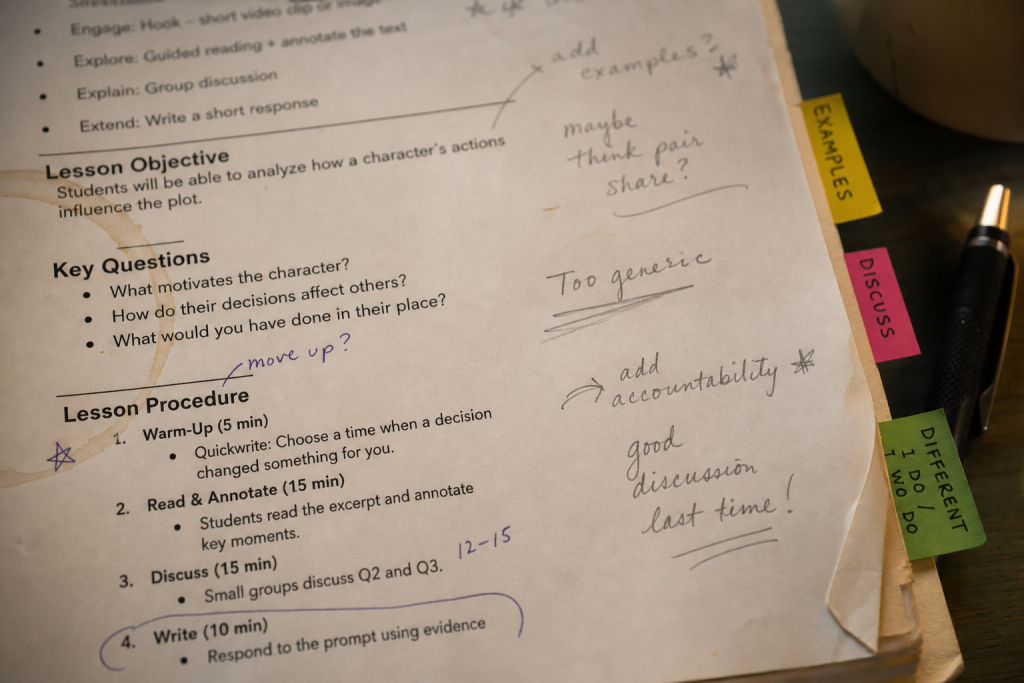
A lot of school work happens outside the neat center of the page.
Not outside the work itself. Outside the official box.
It happens in the margin.
The quick note a teacher writes before a meeting. The extra step added beside a math problem because the printed version moves too fast. The reminder that one student needs larger visual spacing, another needs fewer items, another needs the directions broken into shorter parts. The parent message softened before it gets sent. The lesson adjusted in pencil because the room did not respond the way the plan expected.
That kind of work is easy to miss if you only look at finished documents.
But teachers know the margin is often where the real teaching happens. Not because the center does not matter. It does. The standards matter. The plans matter. The forms matter. The final versions matter.
The margin matters because it is where professionals make the work fit reality.
The finished page is rarely the whole story
One reason teacher work is so routinely underestimated is that people tend to evaluate only the visible artifact.
The lesson plan. The worksheet. The IEP draft. The parent communication. The final deliverable.
But those polished surfaces are usually the result of many smaller decisions:
- what to cut
- what to slow down
- what to explain more clearly
- what to rephrase so it sounds human
- what to scaffold without lowering the target
- what to rewrite so the student can actually enter the task
Those decisions often do not show up in the final clean copy. They show up in the handwritten mark, the note on the side, the revision in the space no one else was planning to count.
That is part of why the margin carries so much weight as a teaching metaphor. It points to the work beneath the visible surface.
The margin is where adaptation lives
Teaching is full of moments where the official version is not wrong, but not enough.
A worksheet may be aligned and still need one more model. A lesson may be solid and still need a slower opening. A documentation draft may be professional and still need warmer phrasing. A student may understand the concept but need a different response path.
The margin is where those adjustments land first.
That is not secondary work. That is the professional work.
It is where judgment appears. It is where responsiveness appears. It is where the teacher stops treating the material like a fixed object and starts treating it like instruction.
TeachSmartHQ™ is built with that reality in mind.
The platform is not trying to pretend that the first output should be the final word. It is trying to give teachers stronger starting points—drafts, structures, and generator outputs that reduce blank-page labor while still leaving room for professional revision.
The margin exists because the teacher still matters.
Why this matters in product design
Some platforms are built around the fantasy of a frictionless final answer. Put in a prompt. Get out perfection. Done.
That is not how real school work behaves.
TeachSmartHQ™ is being built around a different assumption: teachers need useful starting points that are easier to shape, not a machine that claims it has replaced the shaping.
That assumption shows up in different ways across the platform.
PLAAFP Generator™ is live today, and it is framed as a draft-support tool in the teacher’s voice—not a substitute for professional review. Worksheet Generator™ is in active build, and its intended direction emphasizes accessible, differentiated artifacts that can support real instructional decision-making. The roadmap tools continue that same pattern: usable structure first, teacher judgment still intact.
A product built for the margin will not treat teacher revision like a failure. It will treat it like the expected final step of professional use.
The margin is also where care becomes visible
A teacher who is working in the margin is usually doing one of two things.
They are making the work clearer, or they are making it kinder.
Often both.
A shorter direction line. A clearer example. A more usable support. A better transition sentence. A parent note adjusted so it says what needs to be said without sounding hard for the sake of sounding formal.
That is not extra polish. It is the texture of actual educator care.
It is also why systems built only for speed tend to flatten the work. If the platform values output volume more than usable fit, the margin disappears. Everything becomes centered, standardized, and fast at the cost of what teachers actually do to make materials land.
TeachSmartHQ™ is trying to preserve the opposite truth: speed only helps if the result still leaves room for fit.
The margin keeps the work honest
There is another reason the margin matters.
It resists performance.
The center of the page is often where systems speak in their official voice. The margin is where reality pushes back. It is where the teacher says, in effect, “This needs one more step,” or “This is too much at once,” or “This wording will not work for this family,” or “This student can do the thinking, but not in this format.”
That kind of correction is not disobedience. It is instructional honesty.
It keeps the work attached to the learner instead of the template.
That principle matters for a platform too. A product that wants to support teachers should not erase the margin. It should respect it.
Why the metaphor fits TeachSmartHQ™
TeachSmartHQ™ works in the space between finished artifact and working reality.
The platform is not trying to live only at the level of abstract idea. It is trying to support the real point where teachers actually feel pressure: planning, documentation, differentiation, revision, communication, instructional adjustment.
Those are all margin-heavy kinds of work.
They depend on structure, but they also depend on adaptation.
That is why the margin fits as a platform idea. Not because it is decorative. Because it points to the actual layer of work most systems ignore.
The visible document is only part of teaching. The unseen adjustment work around it is often where the expertise lives.
The margin and respect for teachers
There is a respectful way to build for educators and a disrespectful way.
The disrespectful way assumes the polished output is the whole job. The respectful way assumes the teacher is going to revise, adapt, and make professional decisions in context.
TeachSmartHQ™ is choosing the second path.
That does not mean the platform should be vague. It should still be clear about what is live, what is in build, and what is on the roadmap. It should still be clear about pricing, generation caps, and privacy posture. It should still be clear about what each plan includes.
But the platform can be clear about those things while still honoring the fact that teacher work does not end at first output.
Where the work happens
The margin is not separate from the work.
It is where the work becomes usable.
It is where the page gets translated into an actual learner context. It is where a draft becomes a real communication. It is where structure becomes support instead of just format.
That is why the margin matters.
And that is why a teacher-facing platform should stay close to it.
If you want the clearest public snapshot of how TeachSmartHQ™ is trying to build around real teacher workflow, the Teacher Tools page shows the current live platform and roadmap. The About page shows the broader professional stance behind that work.
TeachSmartHQ™ Team