IEP data collection that happens during the lesson, not after it
The IEP data collection sheet that actually gets filled in is the one that fits on a clipboard and takes a few seconds a mark. The sheet is in this post: three boxes, any goal, about ten minutes to make.
Everything else on the long, beautiful, color-coded version is why it’s in a drawer by October.
Why does IEP data collection fall apart by October?
Two reasons, and they feed each other.
The sheet has too many columns. Date, time, setting, goal number, objective letter, prompt level, trials, percentage, initials, comments. Every column is reasonable. All ten together take longer to fill in than the skill took to teach, so the sheet waits until after school.
And after school, it gets filled in from memory. Memory at 3:40 on a Wednesday is generous in some places and grim in others, and it’s never sure which student did what during the fire drill.
A sheet you can’t mark in the moment is a sheet you’ll mark later. Later is where the numbers go soft.
What goes on a sheet you’ll actually use?
Three boxes and one line.
Target. The goal, in words a sub could read. Not “Goal 2b.” Something like “Reads CVC words, 8 of 10.”
Try. The date and what you asked. “9/16, word cards, set C.”
Mark. Whatever the goal counts: a plus or minus, a number, a prompt level.
Then one line underneath: what changes next time. That line is the one that pays for the rest.
Make one on a half sheet of paper, copy a stack, and keep it on the clipboard you already carry. That’s the ten minutes. Or skip the ten minutes and print ours.
How do you use the printable IEP data sheet?
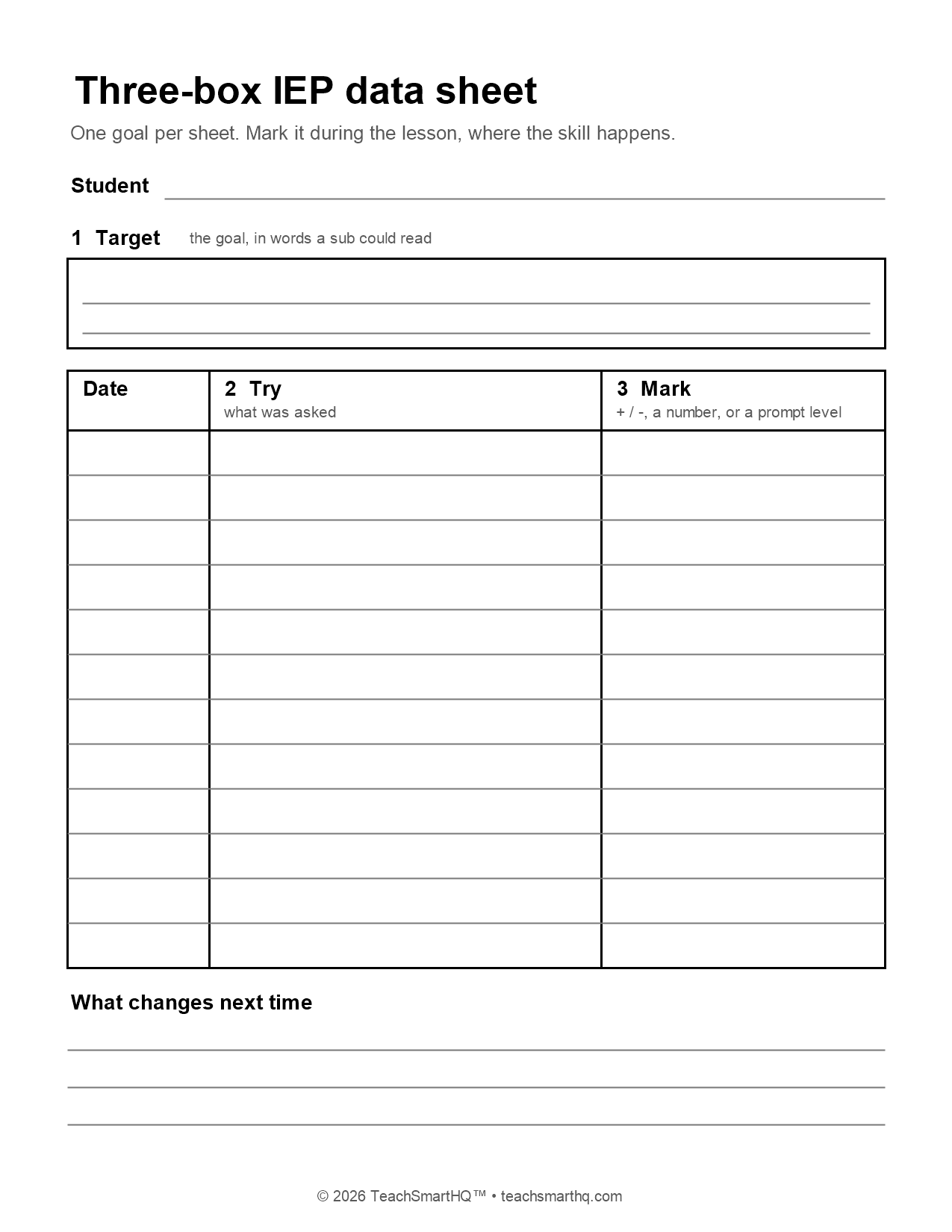
Open the three-box IEP data sheet to print it. It’s one page, letter size, black and white.
Fill in the top once. The student’s first name or initials and one goal, in plain words. One goal per sheet, so the marks all mean the same thing.
Mark a row per try. Date, what you asked (“word cards, set C”), and the mark: a plus or minus, a number, or a prompt level. Twelve rows is roughly a month of checks for one goal on a rotation.
Write the bottom line before you file it. Look down the mark column and write what changes next time. If nothing changes, write that too, and why.
Keep it where the skill happens. Reading goals live in the reading bin. Asking-for-help goals live at the snack table. A sheet in the teacher desk gets marked at 3:40.
How do you match the mark to the goal?
This is the part to get exactly right, because the mark decides what the numbers can tell you later.
- Count, when the goal is how many: words read correctly in a minute, times a student asked for a break using the break card. Write the number.
- Accuracy out of N, when the goal is how well: 7 of 10 subtraction facts. Keep N the same every time, or the scores can’t be compared.
- Prompt level, when the goal is how independently: independent, gesture, verbal, model, physical. Agree on those five words with everyone who marks the sheet, and mark the least help the student needed.
- Duration, when the goal is how long: minutes on task, minutes to transition. Use a timer, not a feeling.
One goal, one kind of mark. A goal that seems to need two kinds is two goals wearing one coat.
When should you mark it during the lesson?
Where the skill already happens. During the warm-up, at the exit question, at the snack table if the goal is asking for help. If the practice is on paper, make sure the page earns its place before it becomes the check.
One student per group per rotation is plenty. Pick who before the lesson starts, write their initials at the top of the sheet, and mark while they work. It takes about as long as initialing a hall pass.

Can one IEP data sheet cover multiple students?
Yes, for skills the whole group practices together. Morning meeting is the classic one: greeting a classmate, answering the calendar question, waiting for a turn. Names down the side, the day’s skills across the top, one mark per box.
A group sheet doesn’t replace the individual sheets for individual goals. It saves you from carrying six clipboards through one circle.
What is the sheet for?
The next lesson, first. A row of minuses on Tuesday is the reason Thursday looks different. Progress monitoring in special education picks up from there, and Lesson planning takes too long covers building Thursday’s other way in without losing the evening.
The family conversation, second. Real marks from real days make a better November meeting than a percentage somebody averaged the night before.
The filing cabinet comes last. It has never once asked a good question at a meeting.