Regrouping worksheets with carry boxes: why they help
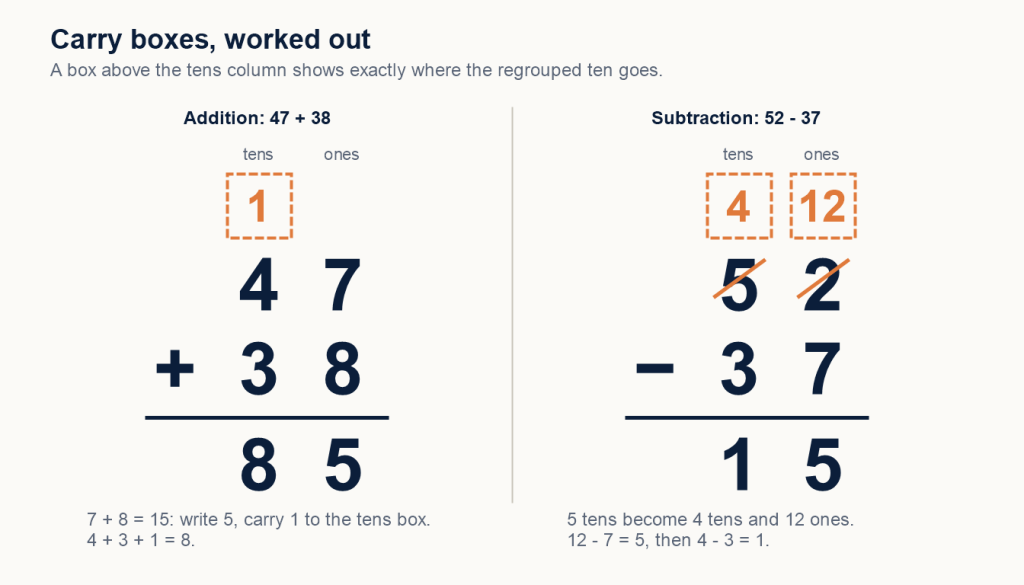
Regrouping worksheets with carry boxes put a small empty box above each column, so a student knows exactly where the regrouped ten goes. In special education math that tiny box does a lot of work: it takes one thing off a student’s working memory and puts it on the page, where it can’t slip away between the ones and the tens.
It’s the same target, 47 plus 38, with one more road in.
What is a carry box on a regrouping worksheet?
A box printed above a column in a two-digit or three-digit problem. In addition, the student writes the carried ten there. In subtraction, a box above the tens column holds the new tens digit after regrouping, and a box above the ones holds the new ones.
For 47 + 38: seven plus eight is fifteen, so the student writes 5 in the ones place and 1 in the box above the tens. Then four plus three plus the 1 in the box is eight. Answer: 85. For 52 – 37: two minus seven won’t work, so five tens become 4 tens (written in the tens box) and 2 ones become 12 (written in the ones box). Twelve minus seven is 5, four minus three is 1. Answer: 15.
Why do carry boxes help students who struggle with regrouping?
Three reasons, and the first matters most.
Working memory. Regrouping asks a student to hold “carry the one” in their head while adding the next column. For a student who loses that one somewhere in the middle, the box holds it for them. The thinking stays with the student; the remembering moves to the paper.
Place value you can see. The box sits above the tens, so the carried digit lands in the tens column every time instead of floating in the margin, beside the wrong number or on the desk.
A step you can check. A teacher looking at a finished page can see two things at once: whether the answer is right, and whether the student regrouped. A wrong answer with a correct carry box is a different conversation from a wrong answer with an empty one.
What makes good regrouping worksheets with carry boxes?
The box is only one part of the page.
- Room. Six to ten problems, not thirty. Big numbers, wide columns, space between problems. A crowded page is a working memory load of its own.
- Columns that line up. Light grid lines or graph-paper squares keep ones under ones and tens under tens.
- The box in the same place every time. Same size, same spot, every problem, so the routine becomes automatic.
- A mix on purpose. Some problems that regroup and some that don’t, labelled or not depending on where the student is, so they practice deciding whether a box is needed at all.
- An answer key that shows the boxes filled. The key should show the carry, not only the answer.
If a page has to earn its place in the lesson, this is how it does it. More on that in when the worksheet earns its place.
When should students stop using carry boxes?
When they don’t need them, and not before. Fade the support in steps rather than taking it away in one day.
Start with the full box. Next, a smaller box. Then a dot or a short line where the box used to be. Then nothing, with the student writing the carried ten above the column on their own. If accuracy drops when a step fades, go back one step for a week and try again. Call it pacing.
Some students keep a carry mark for years, the way adults write small numbers above columns on a receipt. Slower is not limited. The goal is correct regrouping; whether the ten sits in a printed box or a handwritten one is a detail.
How do you check regrouping progress?
Give the same kind of short page, five problems at the same difficulty, once a week or on a rotation, and mark two things: correct answers, and correct regrouping. Put both on the goal’s own page, the way IEP data collection that happens during the lesson lays out.
When the support fades, note the date. If the line dips right after, the fade was a step too big, and the page tells you exactly which step.
And when a student fills the box without being reminded for the first time, write that down too. It belongs in the next family update, next to the number.