AI for Teachers: Why It Still Feels Overwhelming (And How to Fix It)
Teachers keep hearing that AI should save time. Use it for lesson plans. Use it for communication. Use it for documentation. Use it for productivity. On paper, it sounds like exactly what overwhelmed teachers need.
But for many teachers, that is not what it feels like.
Instead of feeling supported, many teachers still feel confused, behind, or unsure where to even begin. In this episode of TeachSmartHQ: The Teacher Systems Podcast, we break down why AI for teachers still feels overwhelming and what has to change to make it actually useful.
Watch or Listen to Episode 2
This episode focuses on the gap between AI training and real classroom use, and why teachers need more than tools if they are ever going to save real time.
Episode Snapshot
- Why AI still feels like extra work for many teachers
- The gap between training and real classroom implementation
- Why scattered tools create more overwhelm
- What it looks like when AI fits into actual workflows
- How TeachSmartHQ approaches AI with systems, not chaos
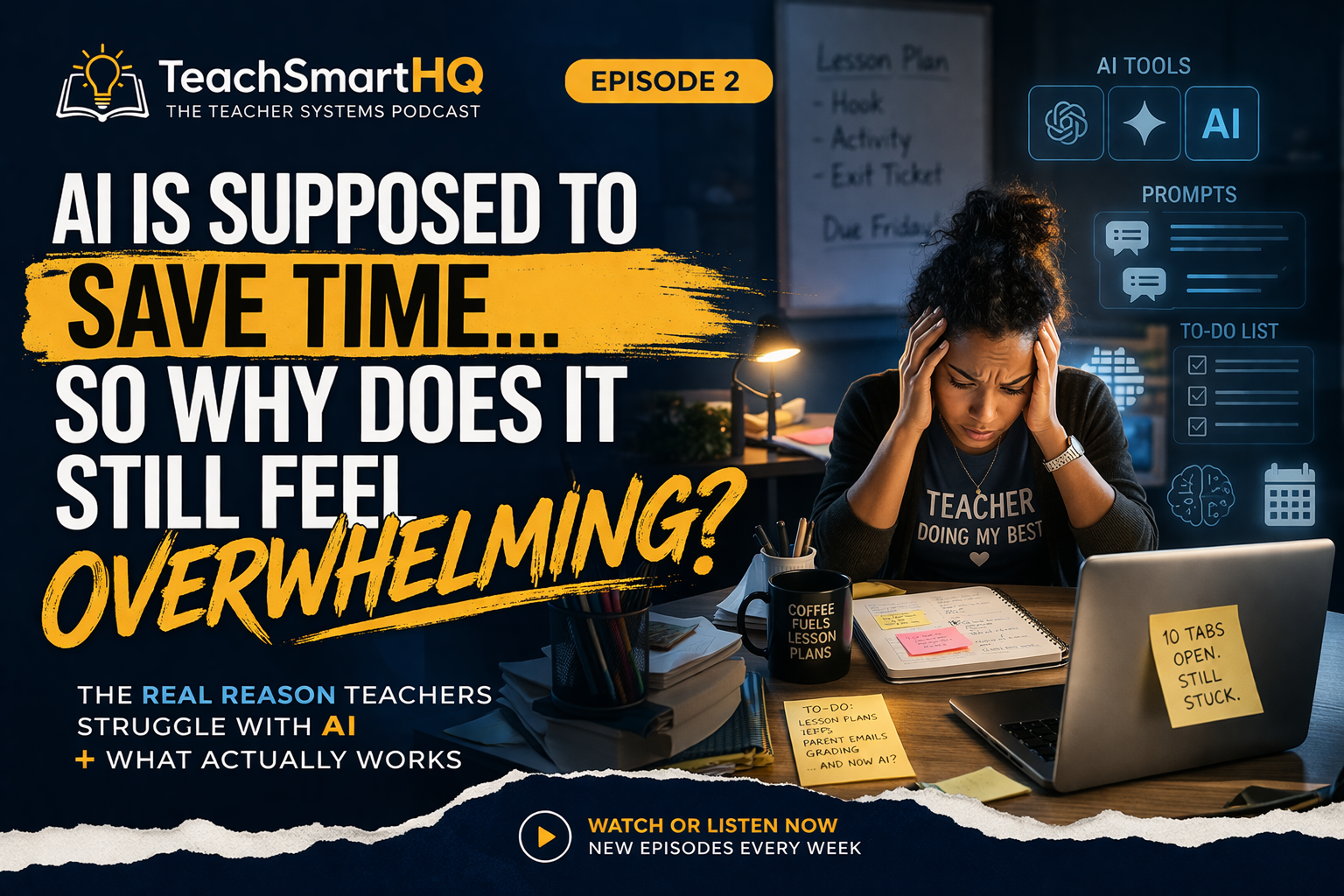
Many teachers are not resisting AI. They are resisting confusion, scattered tools, and one more thing to learn without a system that makes sense in real classrooms.
Why AI for Teachers Still Feels Overwhelming
The problem is not that teachers are unwilling to learn. It is not that schools have ignored AI. In many places, teachers have already sat through professional learning, watched demonstrations, or been given tools to try.
The real problem is that most of it still does not connect to a teacher’s actual day.
A teacher does not just need a chatbot, a prompt, or a platform. A teacher needs to know exactly how that support fits into lesson planning, classroom communication, IEP work, documentation, intervention support, and all the other responsibilities they already carry.
The Training Gap Is Real
This is one of the biggest misunderstandings in education right now. People assume that if teachers have access to AI training, they should be ready to use it. But access does not automatically create confidence.
Many trainings explain what a tool does. Fewer explain how to use it in real classroom situations. That is why teachers can leave a session with new information and still sit down later feeling stuck.
Tools Without Systems Create More Stress
When teachers are introduced to AI in random pieces, it creates decision fatigue. Try this platform. Test this prompt. Compare this tool. Open this tab. Save this resource. Instead of reducing the workload, it can increase it.
That is why AI for teachers only becomes helpful when it is tied to real workflows. If the process is not clear, the tool will not feel helpful for long.
How AI for Teachers Actually Works in Real Classrooms
What works is much simpler than most people think. Start with the real task. Is the goal lesson planning? Parent communication? Documentation? Intervention notes? Once the task is clear, AI can support that specific workflow instead of becoming one more thing to figure out.
This is how AI for teachers starts to become useful. It is not about chasing every new tool. It is about using the right support at the right moment inside a teacher’s existing routine.
What Actually Helps Teachers Save Time
Teachers do not need another list of shiny tools. They need clear systems that reduce the mental load of planning, communication, and documentation. When AI is built into those systems, it becomes practical instead of overwhelming.
This is the shift TeachSmartHQ is built around. Instead of throwing more tools at teachers, the goal is to show how AI can work inside the routines teachers already need to manage.
According to Edutopia, practical classroom implementation remains one of the most important factors in whether educational strategies actually work. That same principle applies here. AI has to connect to real use, not just good theory.
Key Takeaways from Episode 2
1. AI is not the real problem
The bigger problem is how AI is being introduced to teachers.
2. Training alone is not enough
Teachers need classroom application, not just surface-level exposure.
3. Systems reduce overwhelm
A repeatable workflow is more useful than a pile of disconnected tools.
4. Real use matters most
If AI does not fit a teacher’s actual day, it will not feel sustainable.
Want to See What AI for Teachers Looks Like with Real Structure?
Explore the TeachSmartHQ preview portal to see how teachers can use AI with less confusion, less overwhelm, and more clarity.
Visit the Preview Portal